
Survey first: $300–$750
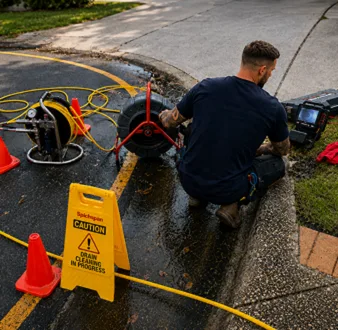
A recorded camera run with distances marked. Yours to keep, and usually credited if the work goes ahead.
We camera the line first, show you what is actually wrong, and then tell you whether relining is the right answer. Often it is. Where the pipe has collapsed or lost its fall, it is not, and we will say so rather than sell you a liner that disappoints.
Relining is a structural repair, not a cleaning method, and the distinction matters when you are comparing quotes. Jetting restores flow through a pipe that is still cracked. A liner restores the pipe.
That also means it is not always the answer. It cannot correct a run that has sagged or lost its fall, and it has nothing to line against where a section has collapsed. A camera survey separates those cases in about an hour, and the answer changes the cost by a multiple.
On stable ground a short patch over a single defect is often the proportionate repair. On reactive soil it frequently is not, because the movement that opened one joint has been working on every other joint in the same run for the same number of years.
That is worth knowing when you compare quotes. The cheaper patch can be the right call, but on this ground the full-length liner is more often the one that ends the problem rather than relocating it a metre.
A listing does not stop you repairing a drain. What it restricts is change that is visible or that disturbs significant fabric, which is precisely what a trenchless repair avoids.
In practice that makes relining the path of least resistance on a listed or conservation-area property: nothing is removed, nothing changes above ground, and there is no reinstatement to get approved.
People are often surprised that a drain laid before the war is a relining candidate rather than a replacement. Age alone does not decide it. A clay line with a sound barrel and tired joints is close to the best case for a liner.
The cases that genuinely need excavation are different: a collapsed section, a run that has lost its fall, or a pipe crushed out of round. A camera separates those in an hour, and the answer changes the cost by a multiple.
An open joint leaks in both directions. On a low-lying block that means stormwater and groundwater entering the sewer through cracks, which is called infiltration, and it quietly overloads a line that would otherwise cope.
Heavy rain surges through the older stormwater drains serving these established blocks, and they choke and overflow quickly.
It shows up as a system that backs up in wet weather and behaves perfectly in dry. If that is the pattern, sealing the run is the fix, and no amount of clearing will reproduce the result.
Removing a mature tree is expensive, often needs approval, and frequently does not solve it: the roots already inside the pipe do not leave when the trunk does, and the joint is still open for the next one.
The suburb’s leafy established streets and backyard trees send roots probing into aged pipe joints, a top cause of recurring blockages here.
Relining lets both things be true at once. The garden stays as it is and the drain stops being a route to water. For most owners that is the whole appeal, and it is why no-dig gets specified on established blocks far more often than on new ones.
Strathfield South’s interwar and Federation homes often still run original earthenware pipes that crack and let blockages take hold over time.
On a period property the drainage repair is rarely the expensive part. Tessellated verandah tiles, original brick paving, a mature garden or a heritage-listed frontage all cost far more to reinstate than the pipe underneath costs to fix.
That is the argument for trenchless in one sentence. The liner is drawn through an existing opening and cured in place, so the surface above is never disturbed and there is nothing to match, replace or explain to council.
A short patch, sometimes called a junction repair, seals one defect and is the proportionate answer when the rest of the run is sound and the ground is stable.
A full-length liner is right when the camera shows the same failure repeating along the run, which on an old clay line it usually does. Paying for a patch on a line with twenty tired joints is how people end up paying twice.
A recorded camera run with distances marked. Yours to keep, and usually credited if the work goes ahead.
The prevailing 2026 Sydney range for residential sewer relining.
Proportionate for one fault in a sound run. We will recommend it over a full liner when that is what the camera shows.
For a run failing along its length, which on old clay is the common finding.
Plus reinstatement. On a bare lawn it can win. Under anything you would miss, it usually does not.
Indicative Sydney ranges for 2026. Your job is quoted in writing after the camera survey. Figures here are indicative of the 2026 Sydney market rather than a quote from us, you get your own number as a fixed price before any work starts.

Nothing is priced until a camera has been down the line. The survey is recorded, distances are marked from a known point, and the footage is yours.
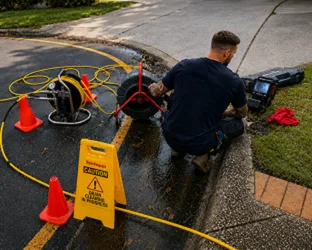
A single defect in a sound run wants a patch. A run failing along its length wants a full liner. A collapsed or sagging section wants excavation. The camera decides, not the quote.
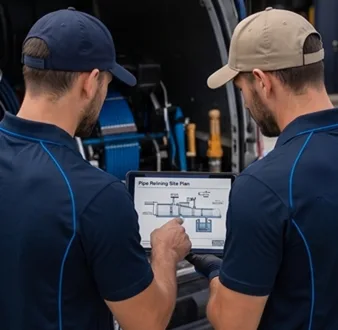
Jet clean, install through the existing opening, cure in place. Water is off for part of the day and nothing above the pipe is disturbed.

Junctions reinstated, final camera run, and the compliance paperwork where the work is notifiable. You keep both recordings.
Send it through and we will come back with what it is likely to be, what the survey costs, and whether relining is even the right conversation.
Cost, lifespan, method, and the cases where a liner is the wrong answer.

Call for the fastest answer, or send the form and we will arrange a camera survey before anything is quoted.

Leave your details and our local Strathfield South team will call you back fast.